Showing posts with label DSWD. Show all posts

Sunday, June 30, 2013

CBHP project with DSWD ends

The VPHCS has concluded its two-year capability-building project funded by the Bayan Muna Party-List and supported by the Department of Social Welfare and Development (DSWD) in five barangays in Cebu.

The two-year project which started in June 2011, “Building community-based health programs (CBHP) in Cebu through training, education and services,” was implemented in Barangay T. Padilla, Sitio Ermita Proper in Barangay Ermita, and Sitio Lawis in Barangay Pasil in Cebu City, Sitio Back of Matimco, Barangay Subangdaku in Mandaue City, and Barangay Canjulao in Lapu-lapu City. Beneficiaries in the barangays included 310 households in Barangay T. Padilla, 240 households in Sitio Ermita Proper, 220 households in Sitio Lawis, 160 households in Sitio Back of Matimco, and 500 households in Barangay Canjulao.

Community health workers attend basic health skills training

The project worked with people’s organizations in the communities, including the Pundok sa Sitio Para sa Kauswagan (PSPK) in T. Padilla, Ermita Fisherfolks Association in Ermita, Pasil Women’s Association in Pasil, KALUWASAN in Sitio Back of Matimco, and the Nagkahisang Kabus sa Lapu-lapu in Canjulao. They have health committees with community health workers (CHWs). 

Health education on dengue fever in Canjulao

A series of health skills trainings of three levels were conducted for 75 CHWs in the five barangays in order to equip them with basic knowledge and skills to render preventive, promotive and selective curative care to the residents. Health education classes were also conducted among residents in the areas to promote health awareness with the aim to empower them in terms of health care delivery on common health problems that can be prevented in the community level. The VPHCS staff also guided, monitored and upgraded the knowledge and skills of the trained CHWs in between trainings as they delivered their health services to the residents.

Health education on acute respiratory infection in T. Padilla

The project is highly significant today with the prevalence of common health problems that can be addressed in the community level. It has been observed that people seek tertiary care in the hospitals when they are already affected with serious illnesses that could have been prevented in their early stage in their homes. With increased health awareness and capacity in knowing, preventing and taking care of their own health needs through home remedies and indigenous resources in their communities, the incidence of serious illnesses and preventable ailments can be lessened. Eventually, the high cost of hospital care which unfortunately is now generally shouldered from out-of-the pockets can also be lessened. In the long term, quality of life can be enhanced.

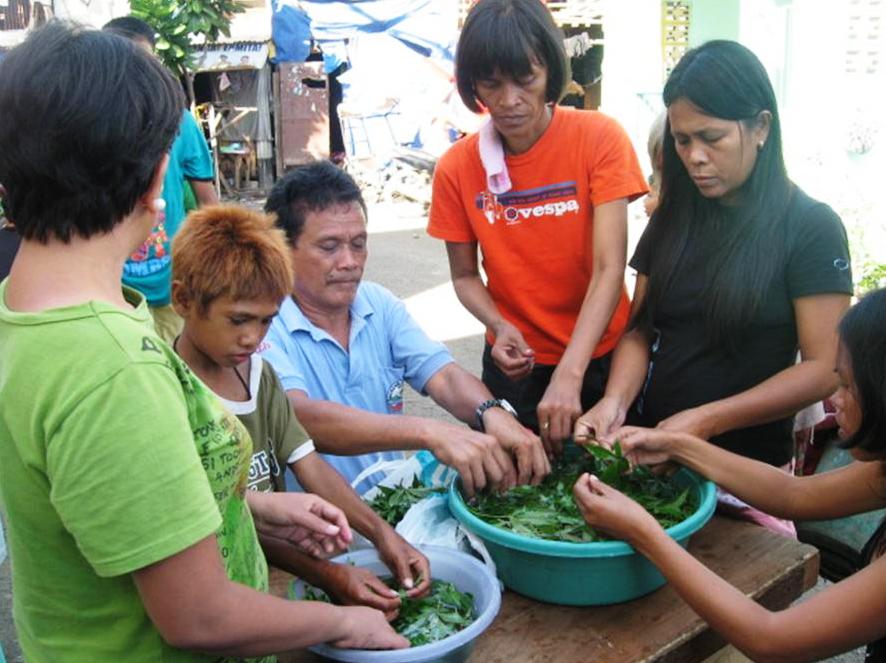
Community health workers making lagundi syrup for cough in Ermita

Community health workers doing ventusa in Canjulao


Tuesday, June 5, 2012

CBHP project with DSWD

The VPHCS continues its health capability-building project funded by the Bayan Muna Party-List and supported by the Department of Social Welfare and Development (DSWD) in five barangays in Cebu.

The two-year project which started last June 2011, “Building community-based health programs (CBHP) in Cebu through training, education and services,” is implemented in Barangay T. Padilla, Sitio Ermita Proper in Barangay Ermita, and Sitio Lawis in Barangay Pasil in Cebu City, Sitio Back of Matimco, Barangay Subangdaku in Mandaue City, and Barangay Canjulao in Lapu-lapu City. Beneficiaries in the barangays include 310 households in Barangay T. Padilla, 240 households in Sitio Ermita Proper, 220 households in Sitio Lawis, 160 households in Sitio Back of Matimco, and 500 households in Barangay Canjulao.

Members of the Ermita Fisherfolks Association pick lagundi leaves before boiling them into a decoction and a syrup as a cough medicine.

A community health worker in Ermita takes the blood pressure during a regular community clinic.

Health services including operation blood pressure are conducted in the people’s organization’s health center in Sitio Back of Matimco.

The project works with people’s organizations in the communities, including the Pundok sa Sitio Para sa Kauswagan (PSPK) in T. Padilla, Ermita Fisherfolks Association in Ermita, Pasil Women’s Association in Pasil, KALUWASAN in Sitio Back of Matimco, and the Nagkahisang Kabus sa Lapu-lapu in Canjulao. They have health committees with community health workers (CHWs). 

VPHCS staff Jessica Pejo conducts a health education class for mothers in Canjulao.

Health skills trainings were conducted for 75 CHWs last year in order to equip them with basic knowledge and skills to render preventive, promotive and selective curative care to the residents. Health education classes were also conducted among residents in the areas to promote health awareness with the aim to empower them in terms of health care delivery on common health problems that can be prevented in the community level. The VPHCS staff also guide, monitor and upgrade the knowledge and skills of the trained CHWs in between trainings as they deliver their health services to the residents. More trainings and health education activities are expected to continue this year. 

VPHCS staff Irish Ramirez talks to mothers in Canjulao on nutrition.

The project is highly significant today with the prevalence of common health problems that can be addressed in the community level. It has been observed that people seek tertiary care in the hospitals when they are already affected with serious illnesses that could have been prevented in their early stage in their homes. With increased health awareness and capacity in knowing, preventing and taking care of their own health needs through home remedies and indigenous resources in their communities, the incidence of serious illnesses and preventable ailments can be lessened. Eventually, the high cost of hospital care which unfortunately is now generally shouldered from out-of-the pockets can also be lessened. In the long term, quality of life can be enhanced. 

VPHCS Dr. Erlinda Posadas conducts blood sugar screening for diabetes mellitus in T. Padilla.

Wednesday, October 13, 2010

VPHCS seeks accreditation from DSWD

A representative of the Standards Bureau of the Department of Social Welfare and Development (DSWD) Central Office recently visited the Visayas Primary Health Care Services, Inc.

Mr. Hernan Z. Perez met with the management committee and staff of the VPHCS last September 23 – 24 as part of the accreditation process of the VPHCS with the DSWD.


The accreditation process follows DSWD Administrative Order No. 1 7 series of 2008 “Rules and Regulations on the Registration and Licensing of Social Welfare and Development Agencies and Accreditation of Social Welfare and Development Programs and Services” which regulates and enforces social welfare and development standards to both public and private organizations in the country that engage in social welfare and development activities.

The VPHCS was given by the DSWD a Certificate of Registration and License to Operate as a social welfare and development agency (SWDA) on June 28, 2010. This means that the VPHCS is officially recognized by the DSWD as a SWA within the purview of social welfare and development and has a legal permit to operate as such.

Accreditation would mean that its programs and services have met the minimum standards set by the government

Being a registered and licensed SWA, the VPHCS is now included in the DSWD's Registry of Registered, Licensed and/or Accredited Social Welfare SWDAs, will receive technical assistance from the DSWD on programs and services implementation; can participate in DSWD's capability building and skills enhancement; can receive endorsement for duty free entry of foreign donations; and receive other benefits and privileges that may be provided from time to time.

After being accredited, the VPHCS shall also enjoy additional benefits including, for level 1 of accreditation, publication of VPHCS good practices and success stories in the DSWD publications and posting on the DSWD website; and endorsement of project proposals; level 2, paper presentation abroad, depending on available opportunities; and nomination for travel local and abroad to participate in relevant training/conferences as part of the Philippine delegation; and level 3, plaque of recognition and cash incentive; recognition a model SWDA and laboratory for trainings and research; and authority to undertake training on their expertise and to charge corresponding fees.

Mr. Perez went through the documents submitted by the VPHCS in its application for accreditation, including the VPHCS manual of operations, profile of employees, profile of the governing board, profile of clients, latest narrative reports and financial statements, and work and financial plan.

He also visited Sitio Back of Matimco, Barangay Subangdaku, Mandaue City, one of the project sites of the VPHCS, where he talked with community health workers and leaders of the people’s organization who are working with the VPHCS in its existing community-based health program.

Mr. Perez made several recommendations to improve the operations of the VPHCS which were welcomed by the management committee. An action plan was later signed by Mr. Perez and Petty Orbeta de Castro, VPHCS executive director signifying the intention of the VPHCS to comply with the said recommendations in order for its accreditation to be granted.


* certificate shall be granted based on the expiration date of the issued accreditation

* certificate. The accredited SWDAs shall receive the following additional benefits

* depending on the level of compliance to set standards:

c.l.
Level 1 of Accreditation
i. Documentation of good practices and success stories shall be featured in
DSWD annual report and Social Welfare and Development Journals as well
as posting on the DSWD website;
ii. Endorsement of project proposals; and
iii.Other
benefits and privileges may be provided from time to time as deemed
appropriate by the Department.

c.2. Level 2 of Accreditation
i.
Paper presentation abroad, depending on available opportunities; and
ii. Nomination
for travel local and abroad to participate In relevant
training/conferences as part of the Philippine delegation.
c.3. Level 3 of Accreditation
i.
Plaque of recognition and cash incentive;
ii. Recognized as a model SWDA and laboratory for trainings and research;
iii.Authority to undertake training on their expertise and charge corresponding
fees; and
iv.Recommendation
for a seat on appropriate councils in areas where expertise
is required.

Monday, July 12, 2010

“Health for all”: The staying power of community-based health programs

By Aurora Fernandez, R.N.

Rosario was quiet and subdued as she slowly walked towards us. Coming closer, it was plain to see how pale and weak she was. Three weeks earlier, she had agonized through 14 hours of breech childbirth, soaking five blankets with blood and without a midwife, delivered a stillborn baby. Shortly afterwards, the midwife showed up to assess the afterbirth and without any compunction, asked for P100.00.

The 33-year-old mother of four, complacent that her previous deliveries had been problem-free, had no prenatal care, even though her husband had urged her several times to see the doctor at the nearby Barangay Health Unit.

Now she was bleeding again, with blood clots the size of fists. She urgently needed hospitalization for a blood transfusion and dilatation and curettage (D & C).

But how to pay for it? Her husband was a gravedigger at the Liloan cemetery, and when there were no funerals, he cut down and pounded buli (a palm tree) trunks all day long to produce enough landang (palm flour) for binignit (a dessert with coconut milk). Lack of money meant their 12-year-old eldest son didn’t start school until last year.

Despite her protests, Rosario was persuaded to go to Vicente Sotto Memorial Medical Center by volunteers and staff of the Visayas Primary Health Care Services (VPHCS). Dr. Erlinda Posadas of VPHCS admitted her and coordinated her treatment, even obtaining the medications and supplies on credit from an outside pharmacy. Working with the radiologist and OB-GYN physician, Dr. Posadas made sure the patient was promptly seen and a successful D & C performed at 11:00 PM the same day, following an ultrasound which showed placental fragments. Since Rosario’s husband had a fever, a friend, Julie, stayed with her overnight at the hospital.

Julie described the chaos at the emergency room that night as a scene straight out of Dante’s Inferno: nightmarish, frightening, and harrowing, with bloody patients moaning and screaming in pain while others waited desperately for medical attention. Two other postpartum patients lay on cots in the ER hallway while their families tried to find the money for a D&C. It was the kind of moral dilemma that drove doctors to despair. But Julie was also left with the unforgettable image of a no-nonsense doctor – Dr. Erlinda Posadas – whose compassion for a patient far exceeded ordinary expectations.

---0---

Trying to make sense of the Philippines’ health care system where “those with the greatest need have the least access” is an exercise in futility. Barely propped up by Philhealth, the government health insurance system only covers 15 percent of hospitalization, medications and selected outpatient procedures, but NOT regular preventive medical check-ups – and the patient still gets slapped with a huge bill on discharge from the hospital.

Rosario’s designation as a charity case meant no doctors’ fees, but other services had to be paid for. Julie helped her obtain reimbursement for the loaned medications from the municipal government, but bureaucratic red tape at the local DSWD (Department of Social and Welfare Services) forced her to return three times before finally getting financial aid.

With the support of VPHCS, Rosario did not have to pay anything, but the whole episode was sobering. It pointed to the need for a rational health care system accessible to those without the means to pay, throwing into sharp relief the necessity for systematic reproductive health education and outreach not just to women of childbearing age and adolescents, but to entire barangays and local government units (LGUs). At the very least, it showed the need for easier access to financial assistance in LGUs -- services paid for by tax monies.

If not for timely intervention from VPHCS, Rosario would now be another statistic in the unrelenting maternal mortality data of this country, where eleven women die from maternal causes every single day, a tragic loss which not only has a profound personal and societal impact but also has economic consequences for years to come. Rosario’s stillborn infant did become a statistic: Philippine infant mortality rate remains at 34/1000 (Thailand’s is 18.23/1000).

--- o ---

What is Visayas Primary Health Care Services and what does it do? As a community-based health program (CBHP), VPHCS, which has been in existence for 30 years, provides free or low-cost health care services to indigents in urban and remote rural areas in Cebu and Bohol. It is a limited safety net for those who fall through the cracks of government health care, but its proven ability to network with other health care practitioners – the specialists in tertiary care, for example – tremendously facilitates provision of services. One of its strong points is its ability to navigate the bureaucratic hospital maze and coordinate essential services. Another is its holistic orientation which includes the promotion of integrative medicine and appropriate technology, specifically acupuncture, homeopathy, reflexology and herbal meds.

In July 2006, VPHCS initiated a reproductive health program called YO! Lead or Youth on the Lead. Funded by Planned Parenthood Federation of America, YO! works with youth organizations in schools and local communities, developing leadership and life skills and providing information and access to reproductive health care services in office clinics and mobile medical missions.

CBHPS embody the principles of primary health care declared at the 1978 Alma Ata International Conference on Primary Health Care: fair, equitable and efficient health care services; community participation in decision-making; and an emphasis on education and preventive health. These principles are evident in the medical missions requested by various barangays and the annual training and skills update of community health workers.

CBHPs work without fanfare and with modest remuneration, their vision carried out by dedicated and selfless staff and volunteers in numerous communities throughout the Philippines - and in the United States. Seminal and groundbreaking, CBHPs deserve a place in the country’s Bantayog ng mga Bayani (Monument to Heroes) for their proven record of public service which has saved – and continues to save – the lives of countless Filipinos.

Aurora Fernandez, R.N. is a retired public health nurse based in California who believes that health care is a human right that should be accessible to everyone regardless of ability to pay. For her, a healthy, productive population strengthens and contributes to nation-building.

Search This Blog