Showing posts with label CHW. Show all posts

Friday, October 12, 2012

The struggle for health is a struggle for social justice

By Laravic Flores 

G
rowing up in a family of activists who survived martial law in the Philippines, learning rally chants such as “Makibaka! Huwag matakot!” was just as normal as learning my ABC’s. Throughout my upbringing, my parents emphasized values of social justice and advocating for the marginalized with a purpose to "Serve the People.” As a medical student currently studying in Cuba, one of the guiding principles we are taught in our medical training is the concept of “solidaridad” and the essence of “ciencia y conciencia” -- that as health professionals, we must not only have a strong basis in science and medicine; but moreover, we must have a social conscience that guides our work in solidarity with poor and disenfranchised communities to use the skills we learn in service of the people most in need. It is with these principles gleaned from both my family rearing and my Cuban medical training that I decided to travel to my homeland this past summer to work with community-based health programs in the Philippines (CBHP’s) and to volunteer with the medical mission relief efforts in response to the floods that affected over 2 million people in the city of Manila. 

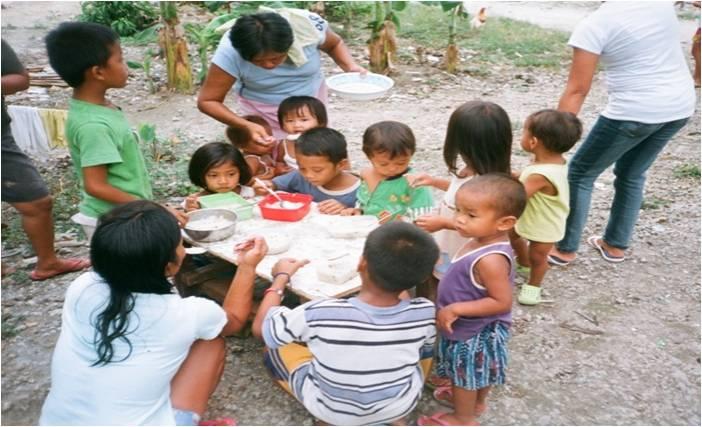
Laravic (center, seated), with a family in Barangay Canjulao, Lapu-lapu City.

I was privileged to have had the opportunity to work with Council for Health and Development (CHD) and Visayas Primary Health Care Services, Inc. (VPHCS) who facilitated my itinerary and integration with community-based health programs in the Philippines (CBHPs) both in Manila and Cebu in September 2012. Working with these organizations contributed a great deal to my learning experience and was a valuable addition to my ongoing medical education and development as a future physician dedicated to working with underserved communities. CBHPs and Community Health Workers (CHWs) follow a primary care community empowerment model similar to that which we are taught in Cuba – that health must be viewed from a bio-pyscho-social perspective. As such, in addition to providing medical care, there must also be education and advocacy to address the political, social, and economic factors that affect health. Working with various CBHPs and speaking to CHWs, I gained a better understanding of their experiences promoting health and well-being in their communities through providing free basic health services, and conducting outreach and education that emphasize disease prevention. In addition, participating in political activities that advocate for policies that are pro-people and consider the needs of marginalized communities illustrated the importance of community organizing to overcome past and current struggles. 

Laravic with health workers of the Ermita Fisherfolks Association 
in Barangay Ermita, Cebu City.

From the fisher folk community in Ermita with a more established CBHP spanning almost three decades, to the more recent CBHPs continuing to develop in communities in Mandaue City and Lapu-Lapu City – despite the differences in localities and years of experience, the essence of their work and principles remain the same. CHWs are not only responsible for healing acute physical illnesses in their communities, they are also essential to community building and community organizing in order to address the social ailments endangering their survival and well-being. It was precisely because CHWs were able to organize their fellow neighbors and build strength in numbers that communities in Ermita and Mandaue City have been able to resist threats of demolition from the local government that would have led to massive displacement of already vulnerable communities.

Aside from learning from CBHPs and CHWs about their community experience, my exposure trip also allowed me to see with my own eyes the dire health situation experienced by patients in government health institutions. Walking through the crowded wards in Vicente Sotto Memorial Medical Center, mothers who had just given birth were sitting on the corners of the bed or on chairs nearby. There was no room for them to even lie down because the bed had to be shared by four newborn babies sleeping side-by-side because there were no individual cribs available to them. However, on another floor of the same hospital was another post-partum ward for those with the resources to pay for more comfortable accommodations. These mothers had their own private air-conditioned rooms with amenities that should be provided to every mother and child going through the stress of labor and delivery. Even within the same institution, the disparities due to the privatization of health care were appallingly apparent. Having witnessed this for myself made the forum I attended a few days later on the topic of the corporatization of health that much more relevant.

In the face of the struggles and challenges confronting the marginalized sectors of Philippine society – the rural and urban-poor communities in town centers threatened by demolitions, farmers and indigenous tribes in the mountainside threatened by militarization – the resilience of these communities is a testament to the power of community organizing. And utilizing health as a tool for community organizing speaks volumes to the work of VPHCS and the associated CBHPs and CHWs in implementing this primary care community empowerment model. Integrating with the various CHWs and seeing the passionate work of the VPHCS staff reaffirmed my belief that health must be approached from a holistic perspective. I am very grateful to everyone at VPHCS for hosting me and giving me the privilege to work with them this summer. Through my various experiences, I have seen the dual role of physicians as both healers and as advocates, and I realize the vital role doctors and all those in the health sector have in working towards social change and community upliftment. The struggle for health is a struggle for social justice. Those in the field of health are vital resources in working to achieve that justice.

Laravic Flores was born in the Philippines and later immigrated with her family to the U.S. shortly after the fall of the Marcos dictatorship in 1986. Raised in a family of activist who survived the oppressive years of martial law, her parents shared their deep love for their mother country and the historical socio-political-economic causes of the serious problems still suffered by the majority of people in the Philippines. They instilled values of social justice throughout her upbringing, emphasizing the importance of community organizing and solidarity work with oppressed communities. It is these same guiding principles that led her to study medicine in Cuba and work with CBHP’s in 2012. She is currently studying at the Latin American School of Medicine in Havana, Cuba and is conducting research to explore the topic of “Health and Liberation in Cuba and the Philippines: A Comparative Analysis of Health Care Models from a Historical and Social Justice Perspective.” 

Friday, June 1, 2012

ACT continues support for Bohol project

The VPHCS project with the Asian Community Trust (ACT) of Japan, “Sustaining community-based health programs to promote health and prevent disease in Bohol” is on its third year.

The project is implemented in Barangay Sto. Nino, San Miguel and Barangay Caluasan, Dagohoy, in partnership with the people’s organizations, Hugpong Mag-uuma sa San Miguel (HUMASA) or the Farmers Association in San Miguel and the Mga Mag-uuma sa Lakalsanda Apektado sa Land Levelling (Farmers in Lakalsanda affected by Land Levelling) in Caluasan.

There are 125 households (679 population) in Sto. Nino and 402 households (2,132 population) in Caluasan.

Since the project started in April 2010, it has greatly benefitted the residents who are mostly poor farmers in dire need of health services in their rural areas. Through various programs developed and sustained by the people’s organizations through their trained CHWs and health committees, the project has reaped increased health awareness and improved health practices and rendered basic health services to the people.

A community health worker weighs a child as part of the growth monitoring and nutrition program in Sto. Nino and Caluasan. 
 
A community health worker renders ventusa or cupping therapy, a form of traditional Chinese medicine.

The project witnessed widespread health information dissemination on disease prevention and health promotion, covering topics including home remedies for common ailments, nutrition, basic first aid, family planning and contraception, control of acute respiratory tract infections, and control of diarrheal diseases, among others.

Health services by trained CHWs addressed common illnesses such as upper respiratory tract infections or common colds, diarrhea, fever, gastritis, muscle and joint pains, tension headaches, and skin diseases with the use of herbal medicines, water therapy, ventusa, and over-the-counter medications such as paracetamol, antacids, oral rehydration salts, and common antibiotics. Cases that they cannot handle were quickly referred to the project health services officer and to the health centers or government hospitals for more specialized care. 

A community health worker takes blood pressure. Hypertensive patients are advised on healthy lifestyle and referred to health professionals for proper treatment.

Hypertensive patients were screened by trained CHWs in the series of operation blood pressuring monitoring and were referred to the project health services officer and to the health centers for further work-up for possible complications and associated illnesses such as heart diseases and diabetes mellitus.

A nutrition program was started in the second year in both barangays which did not only have mass feeding of malnourished children identified in operation weighing and growth monitoring but also maintenance of proper nutrition through health information on nutrition, proper food preparation, cheap and easily available food sources and feeding practices to the mothers provided by trained CHWs.

Nutrition program in Sto. Nino and Caluasan fed malnourished children, monitored their growth and taught mothers regarding good nutritional practices.

A family planning program was launched in Caluasan, Dagohoy which included community education classes on reproductive health and contraception and referral by the CHWs of women desiring birth control to the health centers to avail of contraceptives such as pills and condoms.

The third year that started in April 2012 shall sustain the gains of the two years in terms of making the CHWs more capable of addressing the health problems in the communities. Advanced health skills trainings shall be conducted to enable them to manage more difficult medical cases. Special skills trainings shall enable them to effectively launch and sustain their ongoing health campaigns, the nutritional rehabilitation of malnourished children, promotion of proper nutrition, family planning, control of hypertension, and provision of essential herbal and rational Western medicines.

Furthermore, a small community health center shall be constructed in each of the two barangays, which shall serve as venues for the meetings of the CHWs, health education classes, clinics for regular check-ups and services, and the botica sa barangay (village pharmacy). Herbal medicines to be processed by the residents, medical supplies and materials, leaflets on common health problems and essential Western medicines aside from the patients’ medical records will be stocked safely in the health centers.

To strengthen the sustainability of their health programs, the leaders of the people’s organizations shall continue to network with their barangay councils, municipal governments, health centers and civic organizations in order to generate financial and material resources.

These prospects have been planned together with the leaders of the two people’s organizations.


Friday, September 23, 2011

Pasil community health workers continue health program

Under the leadership of the Pasil Women’s Organization, the community health workers (CHWs) in Sitio Lawis, Pasil, continue to render basic health services to the residents.

A river divides barangays Pasil and Ermita.

The CHWs treat common illnesses such as common colds, fever, stomachache, headache and other complaints with the use of herbal medicines such as lagundi, a bronchodilator and expectorant, water therapy, ventusa, and over-the-counter medications such as paracetamol, antacids, oral rehydration salts, and common antibiotics.

The health committee in Pasil.

With their regular blood pressure monitoring, identified hypertensive patients are advised to take their maintenance medicines and referred to the VPHCS office and the Vicente Sotto Memorial Medical Center for further management.

Health information on hypertension and its complications and associated illnesses such as heart diseases and diabetes mellitus is also regularly given.

Meeting of the health committee.

Pasil health committee with Dr. Erlinda Posadas.

A community health worker takes temperature of a child.

A program on the control of tuberculosis which is a common disease in Pasil and other urban poor communities is also underway. The CHWs shall screen residents for TB based on common symptoms such as cough of more than two weeks, afternoon fever, poor appetite and weight loss, and advise them to have sputum examination in the health center for proper management.

Health education on control of hypertension

Sunday, March 27, 2011

Nutrition program in Lawis, Pasil

A nutrition program shall be conducted starting early April for malnourished children in Sitio Lawis, Pasil by the Pasil Women’s Organization (PWO) in coordination with the Visayas Primary Health Care Services, Inc.

In a meeting conducted by the health committee of the PWO last March 26, the program was deemed necessary in order to address the problem of malnutrition among children.

Marites Siton, PWO president (extreme right) conducts the meeting on a nutrition program

VPHCS staff Dr. Erlinda Posadas who was present during the meeting reviewed on the topic nutrition, discussing about the basic food groups, the different types of malnutrition, and ways on how to address the problem.

CHW Rosalie Beronio talks about malnutrition common in Pasil

The community health workers (CHWs) shall conduct an operation timbang for children less than six years old, identify those who are malnourished, and institute a feeding program using locally available resources.

Thursday, March 24, 2011

ACT continues support for Bohol project

Further development of the community-based health program in two rural barangays in Bohol is expected to continue this year with the recent approval of the project by the Asian Community Trust (ACT) of Japan.

The ACT committee through its Executive Secretary Mr. Michio Ito informed the VPHCS after a meeting last March 23 of its continued support of the project “Strengthening community-based health programs to promote health and prevent disease in Bohol” in Barangay Sto. Nino in the municipality of San Miguel and Barangay Caluasan, Dagohoy in the municipality of Bohol. There are 25 households (679 population) in Sto. Nino and 402 households (2,132 population) in Caluasan.

Municipalty of San Miguel, Bohol

The project started in April 1, 2010 in partnership with the people’s organizations, Hugpong Mag-uuma sa San Miguel (HUMASA) or the Farmers Association in San Miguel and the Mga Mag-uuma sa Lakalsanda Apektado sa Land Levelling (Farmers in Lakalsanda affected by Land Levelling) in Caluasan. Community health workers (CHWs) were equipped through basic health skills trainings conducted with knowledge and skills to address the health problems in the communities. As a result, they are now leading their respective people’s organizations in conducting health education classes on nutrition and basic home remedies and rendering health services which include operation blood pressure and ventusa.

A community health worker renders ventusa services

Common health problems identified in the community diagnosis in the two barangays last June included respiratory tract infections, influenza, hypertension, diarrhea, muscle pains and fatigue, and common infections that can be prevented and managed through continuing health education and basic health services that can be rendered by the trained CHWs.

The second year of the project starting on April 1 aims to sustain the services of the trained CHWs and health awareness raising and promotion among the residents, institute a family planning program in Caluasan and a nutrition program to address the problem of malnutrition, and mobilize the people’s organizations to link with the rural health units and other agencies that would address their health needs.

Additional four basic health skills trainings and four special skills trainings for the 20 trained CHWs, monthly community health classes, and four medical missions shall be conducted in the second year.

The project aims to reduce the prevalence of preventable and communicable diseases in both barangays. by empowering the people’s organizations to deliver basic health information and services in their communities and to manage and sustain their community-based health programs.

Tuesday, February 15, 2011

VPHCS partners with DSWD in health project

The VPHCS has partnered with the Department of Social Welfare and Development (DSWD) in implementing a health capability-building project funded by the Bayan Muna Party-List in five barangays in Cebu.

The two-year project, “Building community-based health programs in Cebu through training, education and services,” shall be implemented in Barangay T. Padilla, Barangay Ermita (Sitio Ermita Beach) and Barangay Pasil (Sitio Lawis) in Cebu City, Barangay Subangdaku (Sitio Back of Matimco) in Mandaue City, and Barangay Bankal in Lapu-lapu City. Beneficiaries in the barangays include 310 households in Barangay T. Padilla, 240 households in Sitio Ermita Beach, 220 households in Sitio Lawis, 160 households in Sitio Back of Matimco, and 250 households in Barangay Bankal.

The project works with people’s organizations in the communities, including the Pundok sa Sitio Para sa Kauswagan (PSPK) in T. Padilla, Ermita Farmers’ Association in Ermita, Pasil Women’s Association in Pasil, KALUWASAN in Sitio Back of Matimco, and Casia Matab-ang Residents’ Association in Bankal. They have health committees with community health workers (CHWs) interested and willing to be part of the project.

The project shall train the CHWs and promote health awareness of residents in the five areas with the aim to empower them in terms of health care delivery on common health problems that can be prevented in the community level. Basic health skills trainings of three progressive levels will be rendered to 75 CHWs in order to equip them with basic knowledge and skills to render preventive, promotive and selective curative care to the residents. The VPHCS staff shall also guide, monitor and upgrade the knowledge and skills of the trained CHWs in between trainings as they deliver their health services to the residents.

Health information classes on common health issues existing in their areas will also be delivered to the residents. Furthermore, the project shall deliver health services including medical check-ups to indigent residents in the five communities which shall serve as the practicum of the trained CHWs with the guidance of the VPHCS staff and volunteer health professionals. Medicines shall be solicited from non-government organizations.

The project is highly significant today with the prevalence of common health problems that can be addressed in the community level. It has been observed that people seek tertiary care in the hospitals when they are already affected with serious illnesses that could have been prevented in their early stage in their homes. With increased health awareness and capacity in knowing, preventing and taking care of their own health needs through home remedies and indigenous resources in their communities, the incidence of serious illnesses and preventable ailments can be lessened. Eventually, the high cost of hospital care which unfortunately is now generally shouldered from out-of-the pockets can also be lessened. In the long term, quality of life can be enhanced.

Friday, January 7, 2011

Project with Asmae ends, programs continue

After nearly two and a half years, the partnership between the Visayas Primary Health Care Services, Inc. (VPHCS) and the Asmae- Association Soeur Emmanuelle drew to a close in December 2010, bearing fruits that have benefitted the residents of three urban poor communities in Metro Cebu and the VPHCS itself in many indelible ways. The communities include Sitio St. Mary Grace in Talamban, Cebu City, Sitio Back of Matimco in Subangdaku, Mandaue City and Sitio Salvage in Looc, Lapu-lapu City.

Such partnership started in March 2008 with the first six-months phase, “Community diagnosis” of the three communities, followed by the second phase “Promotion of Environmental Health and Child Nutrition” and “Strengthening the Sustainability Aspect of the VPHCS” in April 2009 to December 2009 and the third phase, “Strengthening and Sustaining the Community-based Health Programs” in January 2010 to December 2010.”

In the three communities, health committees are now leading their respective people’s organizations in health services such as basic home remedies, health educations, operation blood pressure, processing and dispensing of lagundi syrup, dengue campaign, nutrition program and cleanliness drives. Monthly health educations on topics such as respiratory tract infections, tuberculosis, hypertension and nutrition have continued to be launched in the communities.

In Sitio Back of Matimco and Sitio Salvage, all health activities are conducted in the health centers that were constructed with funds from the project and labor from the people themselves.


Health education in Back of Matimco


Medical check up of health workers in health center in Looc


Health center in Back of Matimco


Feeding program in Back of Matimco

Common and essential Western medicines are also dispensed and sold with a minimal profit. The residents have welcomed this small pharmacy in the health center that has provided them a very accessible source of essential medicines such as Paracetamol, antacids and amoxicillin. Records of patients and activities are also well kept in cabinets inside the health center.

Twenty-one community health workers (CHWs) from the areas were trained in three basic health skills trainings (BHST) I.

The community kitchen which was started in November 2009 continues to this day in order to sustain the feeding program of malnourished children. Feeding is conducted two times a week. More than 130 children in the three communities have benefitted from the nutritional rehabilitation.


Weighing of children in St. Mary Grace


Nutrition program in St. Mary Grace

In Sitio Back of Matimco, the residents united under their people’s organization, the KALUWASAN, using shovels and pails, carried gravel and land from the reclaimed land and dumped them in between and below their houses and in footpaths and alleys to prevent flooding. Environmental campaign for cleanliness has also been sustained by the youth organized under the D’Visioners Youth Organization collecting the trash and putting them in big garbage drums.

In Sitio Back of Matimco, a communal toilet was also constructed in 2010 inside the health center which is open to the public since the health center is always open. The CHWs take turns in manning the center and ensuring the cleanliness of the toilet.

Another communal toilet was constructed in Purok Yellow Bell in Sitio Salvage in Looc. Residents used to defecate in the seashore beside the purok or simply throw their wastes to the murky waters underneath their houses.


Community toilet in Looc

A great contribution of Asmae to the VPHCS was the fund raising mission it supported which lasted from January to July 2010.


Training on fund raising with Ms. Lani Bayron

A series of three staff development seminars on fund raising was conducted by Ms. Lani Bayron, fund raising specialist contracted by Asmae. The outputs included the following, namely:

• Training needs analysis on fund raising
• Fund raising organizational policies and procedures
• Resource generation plan for 2010
• Assistance on sustainability planning
• Exploration of foreign and local funders
• Marketing plan for Balay Kahimsog
• Knowledge on social enterprise, program marketing and project development and management.
• Participation by the VPHCS executive director in fund raising seminars in March, June 2010 in Manila with Asmae partners
• Prospect of setting up an endowment or buffer fund for VPHCS.

As a result of the mission, the VPHCSI staff members became knowledgeable on fund raising activities and broadened their understanding about fundraising.

The project has ended but its contributions to the welfare of the people in the communities and the organizational capacity of the VPHCS shall always remain.

Monday, June 14, 2010

Community medicine elective course for UP medical students

The Visayas Primary Health Care Services, Inc. (VPHCS) facilitated the community medicine elective course for eight students of the University of the Philippines – College of Medicine (UPCM) Class 2012 in urban and rural poor communities in Cebu and Bohol last May 15 – 30, 2010.

The elective course was initiated by the Community Medicine Development Foundation (COMMED) in coordination with the UPCM. The COMMED is a non-government organization based in Manila that organizes and brings physicians and health science students to practice, promote and develop community medicine as an integral aspect of community health work.

The eight students currently in their fourth year medical school in UPCM, visited and stayed in urban poor communities in Cebu including Barangay Pasil and Sitio Mary Grace in Talamban in Cebu City, and Sitio Back of Matimco in Barangay Subangdaku, Mandaue City. In Bohol the students stayed in farming and fishing communities in Ubay, Loon and Trinidad.

These communities have existing community-based health programs (CBHPs) with active community health workers (CHWs) and people’s organizations that deliver primary health care services to the residents with whom the medical students integrated and lived. The two-week community immersion enabled the students to understand concepts and actual practice of community health work, organizing and development.

The students learned to analyze health and development problems in the communities in relation to the social determinants of health and realize their role as medical students and doctors in health development work.

The students are Raoul Felipe, Arthur Z. Gallo, Patrick Sy, Ferdinand Luis G. Suarez, Robert Angelo P. Totanes, Carol Stephanie C. Tan, Anthony A. Suguitan, and Lee Edson P. Yarcia.


Photo credit: Arthur Z. Gallo & VPHCS

Sunday, May 16, 2010

Medical and dental mission conducted in Barili

More than 150 patients were served in a medical and dental mission conducted in Barangay Gunting, Barili on April 24, 2010. The activity was sponsored by the Farmers Development Center (FARDEC) and supported by the Visayas Primary Health Care Services, Inc. (VPHCS), the Visayas Climate Action Network, the Community Empowerment Resource Network (CERNET), the local government unit of Barili, and German Doctors of Cagayan de Oro City.

Medical check-up, dental services and free dispensing of medicines were rendered by staff members and volunteer doctors and nurses of the VPHCS.

A survey of the health conditions in the barangay using a questionnaire was also conducted among selected patients during the mission. Results of the survey shall be collated by the VPHCS staff and disseminated to the barangay residents for action.


Saturday, January 30, 2010

FACCHD donates to VPHCS


The VPHCS received a check of $9,000 from the Fil-Am Center for Community Health and Development, Inc. (FACCHD) last January 8, 2010.

Search This Blog